
By Jackson Riddle
It’s here. Quail season began October 28.
But many local hunters, ranchers, and quail enthusiasts are concerned for the northern bobwhite quail population in West Texas.
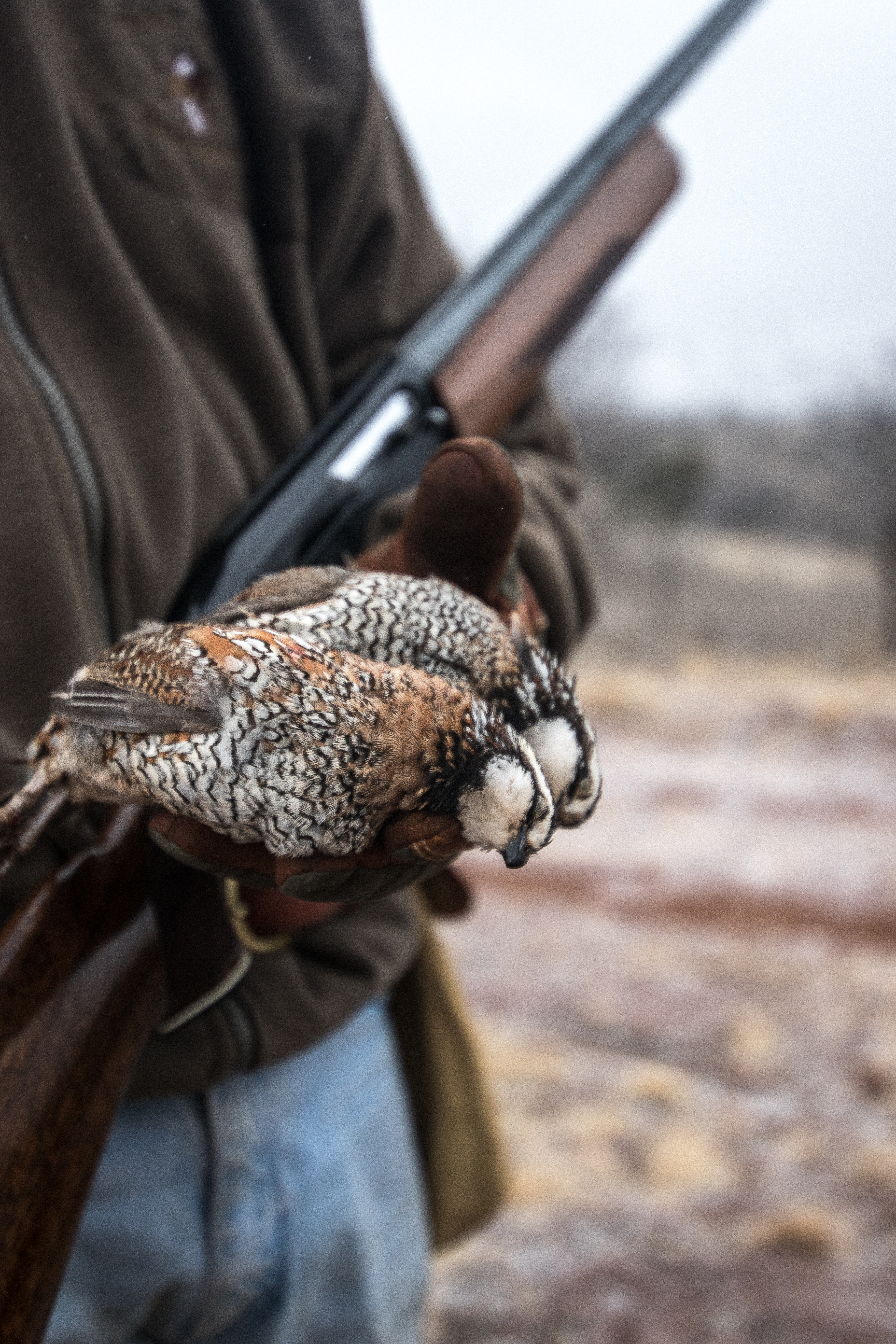
The northern bobwhite quail has a short, brown and tan body. One of the best-known of the northern bobwhite’s calls is a clear, whistled “bobwhite.” According to the American Bird Conservancy, the bird’s habitat is old fields and hedgerows, native grasslands and open forests.
The site also shows the bird’s population trend is declining.
According to the ABC, the North American Breeding Bird Survey shows populations of northern bobwhite dropped 85 percent between 1966 and 2014.
“For years, an explanation for such drastic declines has been elusive,” the ABC site writes. “However, most biologists agree that multiple causes are to blame.”
Local West Texas rancher and quail enthusiast, Ronald Kendall Jr, says he is seeing a major decline in quail numbers throughout his area.
“The fall of 2016 was the last quail season I have seen average bird numbers,” he says. “It’s as if the population is steadily decreasing year by year.”
The Kendalls intensively manage their ranch in Clairemont to improve quail habitat, yet he says the birds are still struggling. Kendall says the neighboring ranches are seeing low bird numbers too, creating fewer visitors to the Clairemont area, and affecting the local economy.
There is much controversy as to why quail numbers have been decreasing across West Texas. Some say lack of proper rainfall and habitat conditions are mostly to blame.
Jude Smith, a wildlife biologist at the Muleshoe and Buffalo Lake National Wildlife Refuge, says rainfall is a major factor for overall quail numbers. Rainfall is highly important for weed and insect growth, he says, which is crucial for a quail’s survival.
“The birds require nesting habitat, and that habitat must have enough height to protect the birds and provide seeds for the birds to eat in the winter,” Smith says. He also explains the importance of insect abundance, which provide the birds with ample moisture and protein.
Other scientists blame something other than habitat and rainfall for the decline in quail populations. One local scientist, Dr. Ronald Kendall, says eye worms are to blame.
Kendall is Ronald Kendall Jr’s father, and he leads a team of scientists at the Texas Tech Wildlife Toxicology Lab. In 2012 Kendall announced he and his team had found scientific evidence backing the claim that parasites are to blame for the decimation of native quail populations. These parasites result in many eyeworms forming in the quail’s eyes.
“These birds usually carry 20-40 worms per eye year-round,” Kendall says. “To scale, that’s equivalent to three No. 2 pencils in your eye.”
Dr. Kendall’s research is well documented on the Texas Tech Wildlife Toxicology Lab website. The site explains that it is actively working towards a cure.
“Since 2015, the Texas Tech Wildlife Toxicology Laboratory and the U.S. Food and Drug Administration have worked alongside each other in the development of a quail-specific medicated feed,” the website says. Kendall’s team claims that initial testing of the feed has produced promising results.
In 2019 Kendall’s work to help the quail population was featured in an article in Texas Monthly. The article is called, “Can the Bobwhite Quail be Saved?” Kendall is clear he believes his approach to combat the eye worm parasite is the best way to save the birds.
Perhaps only time will tell if any solutions to save the northern bobwhite quails are working. In the meantime, Dr. Kendall and his team are actively trapping wild quail to monitor health and eye worm abundance. Jude Smith and Texas Parks and Wildlife are banding quail to track their patterns and survival rates.
On its website, Texas Parks and Wildlife released the Texas Bobwhite Quail Forecast for 2023-24, and the forecast begins with optimism.
“Bottom line, bobwhites in Texas made progress this year,” the site states.
The site goes on to say the population is still far from where the TPWD would like it to be, and September drought may have damaging effects.
“With that said,” the site writes, “bobwhite populations are likely in their strongest position since 2018 and primed to grow if winter and spring conditions are favorable again in 2024.
If you decide to go quail hunting in Texas this year, the TPWD has implemented a 15-bird daily bag limit. A Texas hunting license and Upland Game Bird Endorsement are required to quail hunt.
For more information and to track West Texas quail: https://tpwd.texas.gov/huntwild/hunt/planning/quail_forecast/forecast/
To visit the Wildlife Toxicology Lab’s site:
To learn more about the northern bobwhite quail:
Leave a Reply