
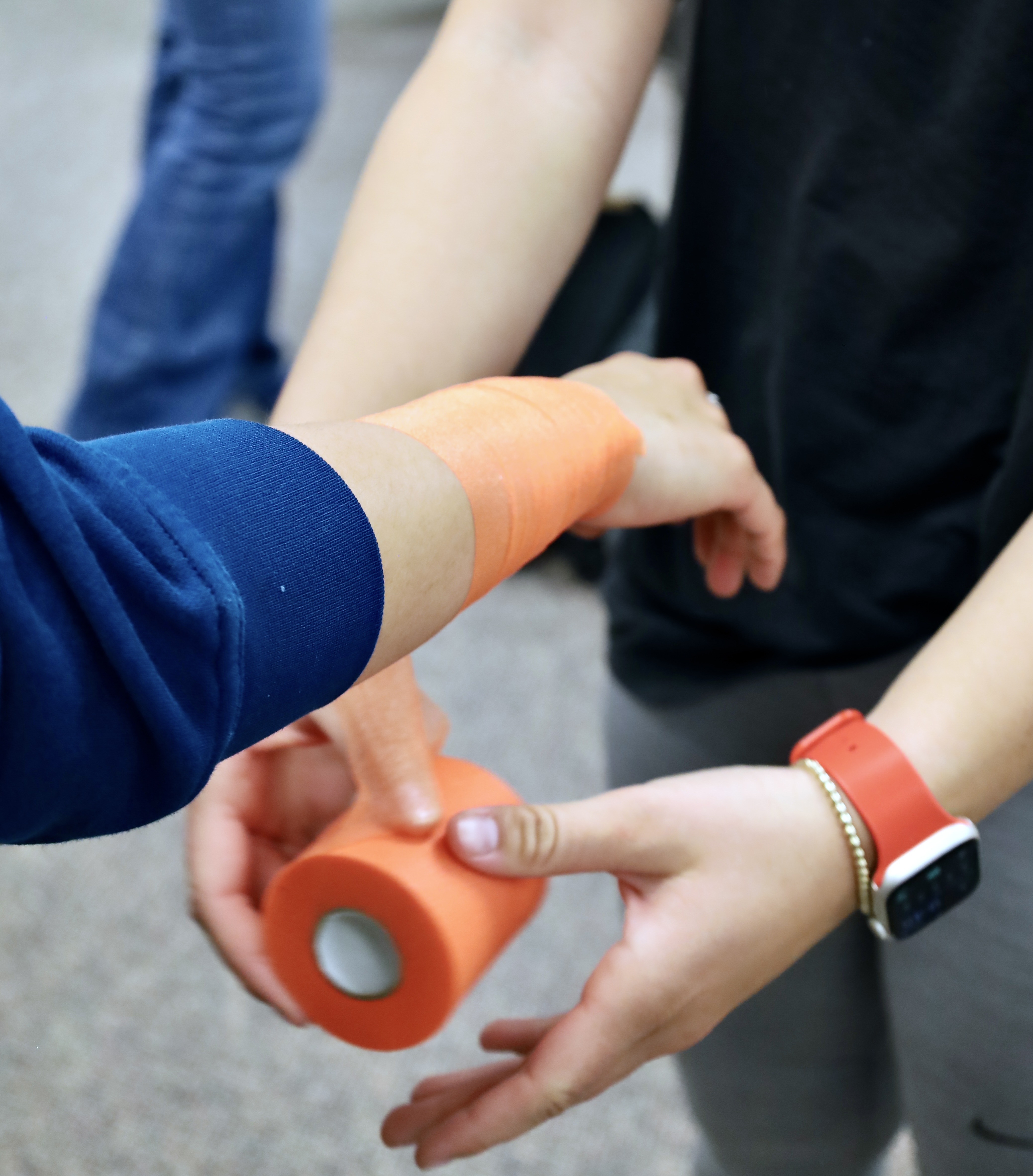
Students in COMM 1316 News Photography took photos of kinesiology students learning how to use shoulder and wrist wraps during KINE 2356 Care and Prevention of Athletic Injuries.
It’s a wrap…literally.
Students in Andres “Andy” Reyes’ KINE 2356 Care and Prevention of Athletic Injuries class recently practiced wrapping shoulders and wrists in their first day of taping lab.
With rolls of beige elastic wrap in hand, students learned the “shoulder spica” wrap. They practiced on each other. Reyes explains this wrap is designed for muscle support and to restrict some motion so it could be used pre or post injury.
“You may use this because, again, it’s preventing that motion that could be causing pain or caused the injury initially,” he says. “And so now we’re preventing that motion.”
Reyes says basketball players hate this wrap because they don’t like their upward motion to be limited. Football players, he says, often need this wrap.
“Even though in this class I only teach one or two different ways to tape something,” Reyes says, “there’s five, ten different ways to tape something. All dependent upon what the specific needs of the athlete is, what the sport is, what event they do in the sport.”
The next type of wrap students practiced was a traditional wrist tape job. Reyes demonstrates how to twist the tape to create an extra “rope” on the top.
“We call that a ‘rodeo wrap’ or ‘bull wrap’,” Reyes says. That extra wrist support is potentially needed in rodeo he says. He also says he uses it a lot with football linemen who don’t want their hands to push too far back.
This class is not required for kinesiology majors, but Reyes says it could be a useful elective for a lot of students going into several career paths.
“So, if it’s somebody interested in becoming a P.A.,” he says, “a doctor, especially in the sports medicine realm, a nurse, a physical therapist, strength coach, this class is beneficial.”
Student Marizza Luevano is taking this class because she says she plans to transfer to Texas Tech to become an athletic trainer or physical therapist.
Student Amber Sanchez is taking the class for different reasons.
“I’m taking it because I’m going into nutrition,” Sanchez says. “And I kind of do personal training so I kind of want to know just in case like I have any people I train, or any clients, get hurt or injured.”
Students cover emergency situations and how to recognize different sport injuries in the next couple of weeks.
They wind up with a taping practical exam the week before spring break.


Leave a Reply