
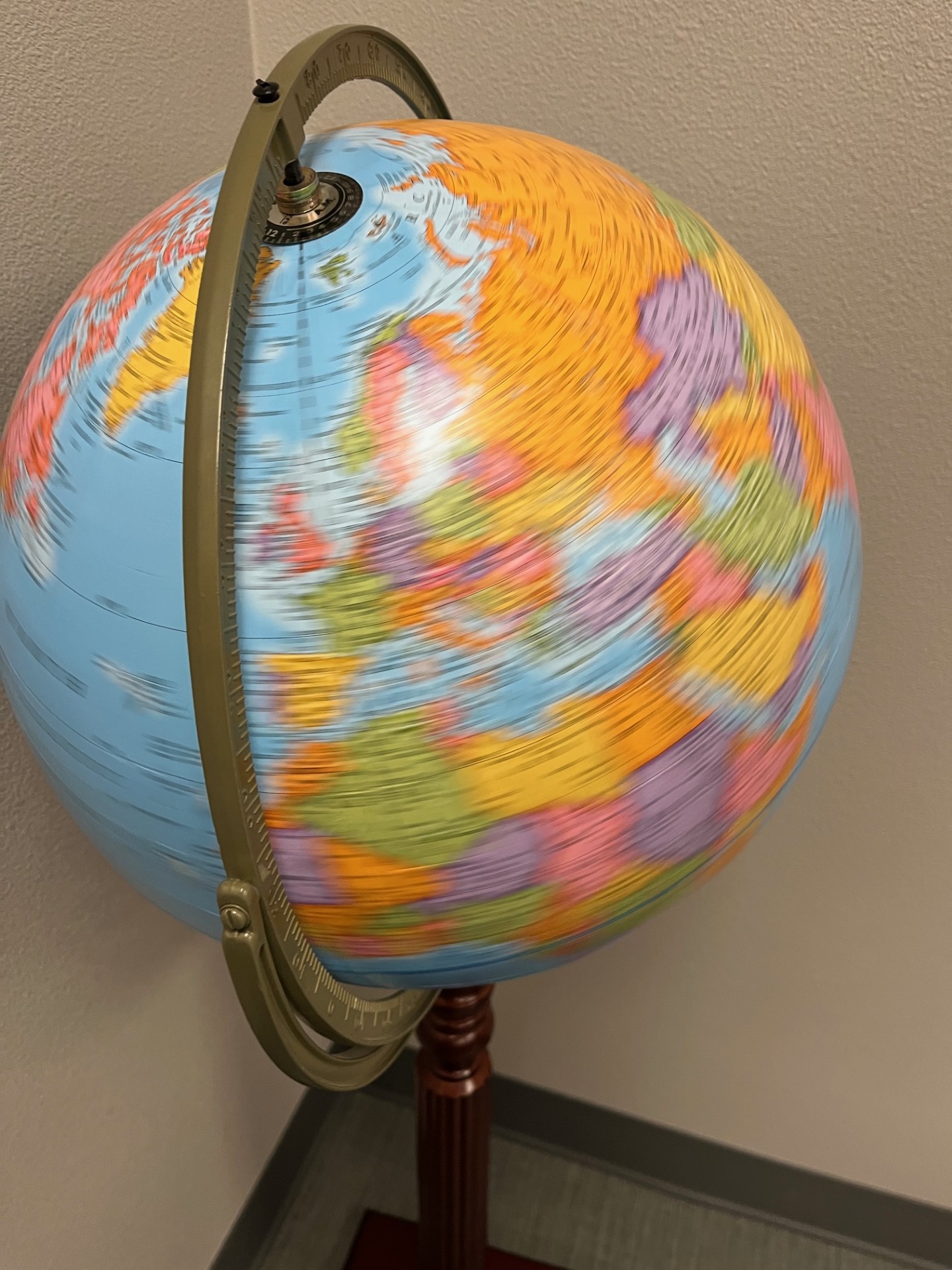
**Editor’s note: Students in COMM 2311.601, Newswriting at the SPC Lubbock Downtown Center, contributed to this story. Students Nicolaus Bazaldua, Elizabeth Hamilton, Landon Smith, Niria Villa, and Raenell Villamor participated in interviewing and researching. Early on, they brainstormed about a creative way to start the story. They also chose quotes and organized paragraphs. Now, they’re ready to repeat the process on their own.
How many countries are between Finland and North Korea?
If you don’t know the answer, don’t feel bad. Only one out of seven students sitting in SPC Instructor Greg Ramzinski’s World Regional Geography class did.
The answer? It’s at the end of this story.
World Regional Geography, or GEOG 1303, meets Mondays and Wednesday mornings this semester at the SPC Lubbock Downtown Center campus.
Ramzinski says he spends eight weeks in the class talking about various regions. The first day of the week students learn about the region historically. Then, he says, in the next class they discuss issues that people in that region may be dealing with.

On this day in the third week of the semester, Ramzinski is discussing how immigration issues in Europe will likely change what Europe looks like 20 years from now.

How does immigration in Europe affect someone here in Lubbock, Texas?
“Do you use olive oil for anything?” Ramzinski answers the question with a question. “What if that went away? If you’re a wine drinker, a lot of wines come out of California. But there’s also a lot of wines that come out of France and Italy. What if that goes away?”
In other words, Ramzinski says, European immigration issues could affect anyone, even here in Lubbock, in the “pocketbook”.

The one thing Ramzinski says he hopes his students take away from this class is the understanding that everything is connected.
“It seems kind of cliché-ish,” he says, “but it’s true. What decisions are made at whatever level city, county, state, national, is going to have an effect somewhere else in the world in some respect.”
And if everything is connected in some way, it is somewhat troubling that it appears so many people seem to know so little about geography.
“People, and not just college students, but people in general, have no concept of where things are,” Ramzinski says. “And it’s interesting because we all have a phone and we can just do our Google map and get from point A to point B. But people can’t look at a blank map and say, ‘Show me England.’ ‘Show me Africa.’”

Ramzinski says that when the state eliminated the requirement for geography in high school, it did a disservice to students.
A U.S. News and World Report article addressed the issue in 2015 with the headline: “U.S. Students Are Really Bad at Geography”.
“I say ‘bad’ is too kind of a word,” Ramzinski says. “I would say they’re ‘terrible’.”
And the latest results from the National Assessment of Education Progress tests, also known as the Nation’s Report Card, appear to back that opinion up.
The NAEP’s website explains nearly 13,000 students in the 8th grade were tested in 2018 about their knowledge of geography. 2018 is the most recent year geography assessment was done.
Results show the average geography test score was three points lower than those from 2014.
The NAEP website also offers results from sample questions students tackled on the 2018 test. For instance, only 26% of eighth-grade students were able to correctly locate major cities on a map.
When asked if GEOG 1303 should be a required course, Ramzinski answers “Yes” without hesitation. But he admits he’s rather biased.
SPC student Wesley Crawford is enrolled in GEOG 1303 this semester. He says he wants to maybe work in Government Information System or GIS surveying.
Student Cooper Fairchild is also enrolled in GEOG 1303. He is an education major, but he says he’s taking the course because he likes history and geography.
“As it is, I’ve learned a lot in this class,” Fairchild says. “Just learn more about what’s going on in different places not just the U.S.”

Ramzinski says his class is packed with lots of information. For instance, he discusses topics like culture, politics, economics and sociology.
Ramzinski says he believes a lack of knowledge about geography and world geography can hurt students when they hit the job market.
“Just knowing what’s going on in Europe and Asia,” he says, “or just in one or the other is a significant step up than students that just kind of come through and stay in their little bubble and don’t watch news, don’t get different news sources, aren’t informing themselves.”
To help students learn about the world, Ramzinski is one of the SPC professors who takes students on study abroad trips.
“It’s an opportunity for students to have an international experience,” Ramzinski says. “To give them a brief glimpse on something outside of West Texas.”
Dr. Elaine Ramzinski, Greg Ramzinski’s wife, started the study abroad program at SPC several years ago. She is an associate professor of college literacy & education at SPC. She’s also SPC’s education abroad coordinator.
This year, 25 people will be traveling with the SPC study abroad program. The group leaves in June for London and Paris
SPC’s website promises the study abroad trip in 2025 will be to Italy. Information about what classes are offered, how to enroll, itineraries, etc., are listed on the site too.

While student Cooper Fairchild says he will not be going on the 2024 trip, student Wesley Crawford says he doesn’t know yet.
By the way, how many countries are between Finland and North Korea? The answer: one.

“Half a world between Finland and North Korea,” Ramzinski says. “That’s Russia.”
Leave a Reply