
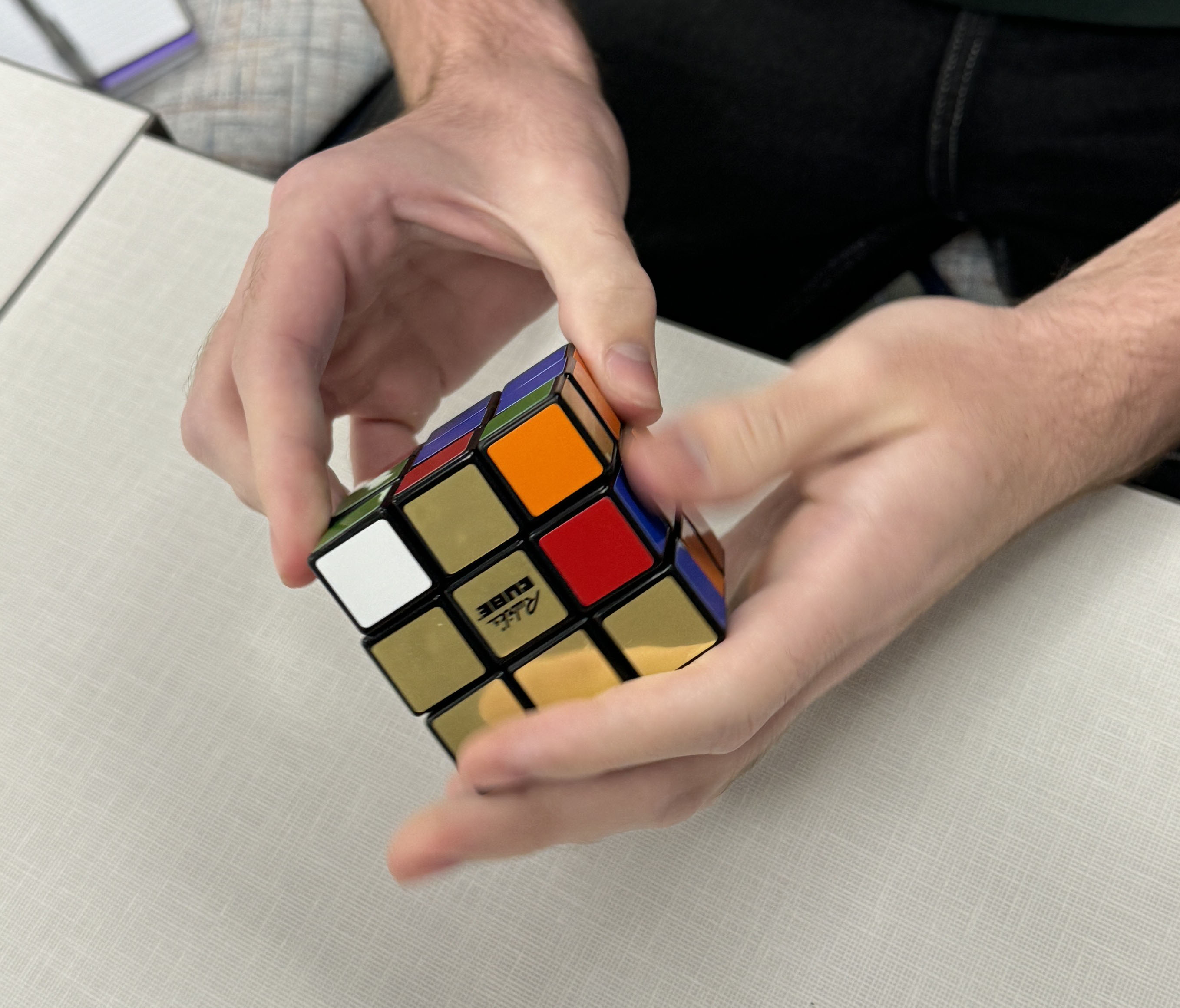
Editor’s note: Students in COMM 2311.601 contributed to this story. As a class they conducted interviews, chose quotes, debated how to organize the story along with where to put pictures. Most of the photographs were taken by Raston Copeland from COMM 2311.601
Here at SPC the celebration started as an ice breaker activity… a way for students to learn each other’s names in an intro to mass comm class.
Fifteen students in the class filled out index cards listing two truths and one lie about themselves. Students tried to guess which of the three things written on each card was a lie.
Analie Huichapa says she didn’t think it was a big deal to list that she can solve a Rubik’s Cube on her card. Why did she put it there?

“I want to say I was on my phone right before,” she says, “and I had seen someone solving one on TikTok so it was kind of in my head already.”
A week later the teacher brought up the Rubik’s Cube topic again in class. The puzzle was featured on the front of a magazine she had run across from October 2023 called The Week Junior.

The magazine explains the Rubik’s Cube was invented 50 years ago, in 1974. It says the cube was created by a Hungarian sculptor and professor of architecture, Emo Rubik.
“He was interested in geometry (a branch of math focusing on measurement),” the magazine says, “and wanted to find a way to demonstrate 3D (three-dimensional) movement to his students.”
Now, out of 15 students in the SPC intro to mass comm class, at least four students spoke up to say they, like Huichapa, can solve the Rubik’s Cube too. So, just for fun, two students volunteered to pass a cube around to prove it. The attempts were timed too.
Huichapa predicted she could solve the cube in under 5 minutes or maybe even 2 minutes.


On the other side of the classroom, Micah Pappas predicted he could solve it even faster than Huichapa. He thought he could do it in under 1 minute.

Is there math involved in solving a Rubik’s Cube?
Jerod Clopton, an SPC assistant professor of mathematics, says that is an “interesting” question.
“So in terms of math,” he says, “it’s really important to realize how many possible ways there are to configure the cube.”
After all, a cube has six sides, and a Rubik’s Cube twists in all different directions.
“Google will tell us,” he says, “are you ready for this? There are 43 quintillion, 252 quadrillion, 3 trillion, 274 billion, 489 million, 856 thousand combinations of the Rubik’s Cube.”
That’s a big number. Another Google search explains a quintillion is a number with 18 zeros after it.
Clopton prepared some handwritten calculations he refers to in order to put that big of a number into perspective.

“Just how big that number is,” he says, “if you were to take that number of cubes and just start stacking them, side by side, depth and height, you would form a cube that is approximately 125.65 miles length, width, height.”
That, he says, is equal to the distance from Lubbock to Amarillo in length and height.
“The math involved for solving the cube,” he says, “it may not be the type of math when you think about 2×2 or 4×4 but what we’re talking about is permutations or rules that get us from one state to the other state.”
In other words, he explains, there are “recipes” or “formulas” out there, if you look on Google, that show how to solve the cube in 60 moves or so.
Back in the intro to mass comm classroom, Huichapa solved the cube in about 2 minutes and 30 seconds. Not her best effort, she says, because the cube she used was new and stiff. Plus, she hadn’t practiced in a while.
Micah Pappas solved it in 1 minutes and 10 seconds. He, too, thinks he could have done better.


“I think if I’d had a better cube,” he says, “I probably could have gotten 45, 30 seconds.”
Despite its age, it appears the Rubik’s Cube still generates plenty of interest. There is an official website for the cube which features a picture of the creator himself, solution guidelines and a timeline of the cube’s history.


Happy birthday Rubik’s Cube!
Leave a Reply