
Story and photos by Meredith Cloud, COMM 2311-601 News Writing.
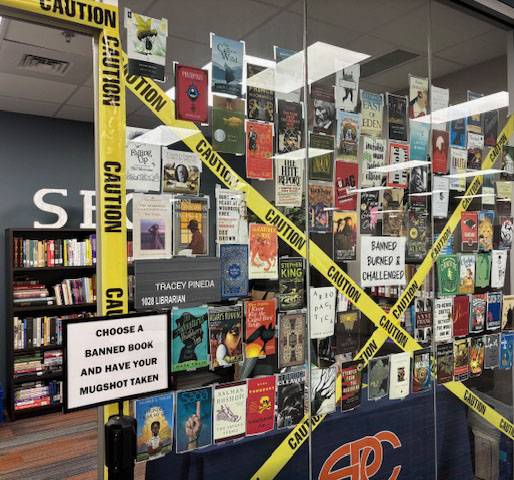
This week, students who come by the small library office at the SPC Lubbock Downtown Center have the chance to stop and take a mug shot. It’s not a real one, of course. No one’s getting arrested.


It’s a chance for SPC librarians to bring attention to the issue of banned and challenged books.
The American Library Association established Banned Book Week in 1982. It’s held annually, typically during the last week of September.
According to the ALA’s website, “By focusing on efforts to remove or restrict access to books, Banned Books Week draws national attention to the harms of censorship.”
This year Banned Books Week runs from Sept. 22 through Sept. 28.
What is a “banned” book? According to the ALA, a banned book is a piece of literature taken off the shelves of a library because of offensive content.
Before a book becomes banned, it has to be challenged. The ALA explains this means someone must formally object to it and give the reasons why to the library that the book is found in.
The ALA reports that in 2023 alone, the number of challenged books rose by 65%.
The organization’s site shows a list of book “classics” that have, over the years, made it on a banned book list somewhere in the U.S. Some of the titles include “The Great Gatsby”, “The Grapes of Wrath”, “To Kill a Mockingbird”, “1984”, and “The Lord of the Flies”.
Do any of those titles sound familiar?
The library window at the SPC Lubbock Downtown Center is covered with book titles that have all been on banned book lists before.


According to data from the ALA’s Office for Intellectual Freedom, more than 100 titles were challenged in 17 different states including Texas in 2023.
Banning books is quite a controversial topic, some are against it, and some are for it.
Nathan Ragland, the director of libraries at SPC, says, “I am adamantly opposed to the concept of banning books. It works against the notion of intellectual freedom and is contrary to the First Amendment of the U.S. Constitution.”
Ragland says, “It is the reader’s job to decide for him- or herself which titles to read or not read.”
Tracey Pineda, SPC librarian at the Lubbock Downtown Center, points out that banned books have quite a history. And that history, she says, has something to do with what she decided to call this year’s Banned Books Week display at the Lubbock campus.
“Well we just called it ‘Banned, Burned, and Challenged’”, she says, “because a lot of books get challenged but don’t necessarily become banned. It was kind of a historical thing too because talking about book banning and book burning and when that has happened in history what books were burned like in Nazi Germany.”
Burning books, she says, used to be a normal way of protest. Objections about a book’s content, she says, could have been for social, religious, economic, and political reasons.
The ALA compiles a list of the most challenged books each year. In 2023, the first five from the Top 10 Most Frequently Challenged Books, based on reports from the field and media coverage, include:
- “Gender Queer: A Memoir” by Maia Kobabe; number of challenges: 106 for LGBTQIA+ content, claimed to be sexually explicit.
- “All Boys Aren’t Blue” by George M. Johnson; number of challenges: 82 for LGBTQIA+ content, claimed to be sexually explicit.
- “This Book is Gay” by Juno Dawson; number of challenges: 71 for LGBTQIA+ content, sex education, claimed to be sexually explicit.
- “The Perks of Being a Wallflower” by Stephen Chbosky; number of challenges: 68 for claimed to be sexually explicit, LGBTQIA+ content, rape, drugs, profanity.
- “Flamer” by Mike Curato; number of challenges: 67 for LGBTQIA+ content, claimed to be sexually explicit.
So what does Tracey Pineda plan to do with the “mug shots” students create outside the library this year? Post them outside the library on the wall for others to look at.


Again, it’s a way of bringing attention to the topic of banned books.
“It’s a relatively easy thing to do,’ she says, “and we usually notify the instructors and sometimes they will even offer extra credit if somebody comes down and does that, because we’ll send them the pictures too.”
Leave a Reply