
Editor’s note: Elijah Levario from COMM 1318 Photography 1 contributed several of the photos in this project along with the how to steps.
First of all, what is one? And secondly, why would you want to?
The answer to the second question is easy: It’s fun. It also teaches you something about optics.
The answer to the first question is a little more complicated.
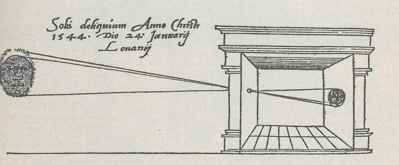
“Camera obscura” literally means “dark chamber” in Latin. It is basically a darkened room or box that lets light through a small opening on one side and projects an image onto the other.
It’s a very old device. Depending on what you read, the oldest mention of how it works dates back to the 5th century B.C. Aristotle noticed the principle behind it worked to show a solar eclipse in the 4th century. By the 16th century, it was being used as a tracing or drawing aid.
The earliest camera obscuras had no way to save the images they projected. But they are still considered to be a simple camera that teaches something about optics.
In its simplest form, the image a camera obscura projects is both upside-down and backwards. The reason why has to do with physics.
South Plains College Physics Professor Kim Bouldin explains it using the following graphic.

The light going through the top part of the lens, she says, gets focused to the bottom of the image.
“The opposite happens to the light through the bottom part of the lens,” Bouldin says, “thereby flipping the image.”
Light works the same way in modern day cameras and microscopes. The image is actually upside-down and backwards unless there is a mirror inside to flip the image right side up.
Don’t believe it? Try making your own.
Photography students in COMM 1318 Photography 1 made crude ones described in the steps below using a Youtube video as their guide. There were a lot of “cool!” comments when they finished and looked through them.
How to make one
The supplies you will need


- One paper towel roll or two (optional)
- Scissors
- Tracing paper
- Foil
- Rubber bands or tape
- Thumb Tack
- Step 1: Cut the paper towel roll in half length wise. Then cut one of the two pieces (piece 1) down the middle so it will fit inside the other piece (piece 2).

- Step 2: Stretch a small square of tracing paper across the top of piece 1 and tape it in place. You could use a rubber band instead.
- Step 3: Stretch a small square of foil across the top of piece 2 and tape it in place.
- Step 4: Use a thumb tack to poke a small hole in the foil on piece 2. This will be the camera’s aperture. Start with a small hole. You can always make it larger.

- Step 5: Slide piece 2 inside piece 1.

- Step 6: Try to go outside when the sun is bright. The brighter the better, but do not look directly at the sun. Sliding piece 1 back and forth will help focus and make the image you see smaller and larger.


- Step 7: The image you see will be upside down and backwards.
Cool! Happy viewing.

###
Leave a Reply