
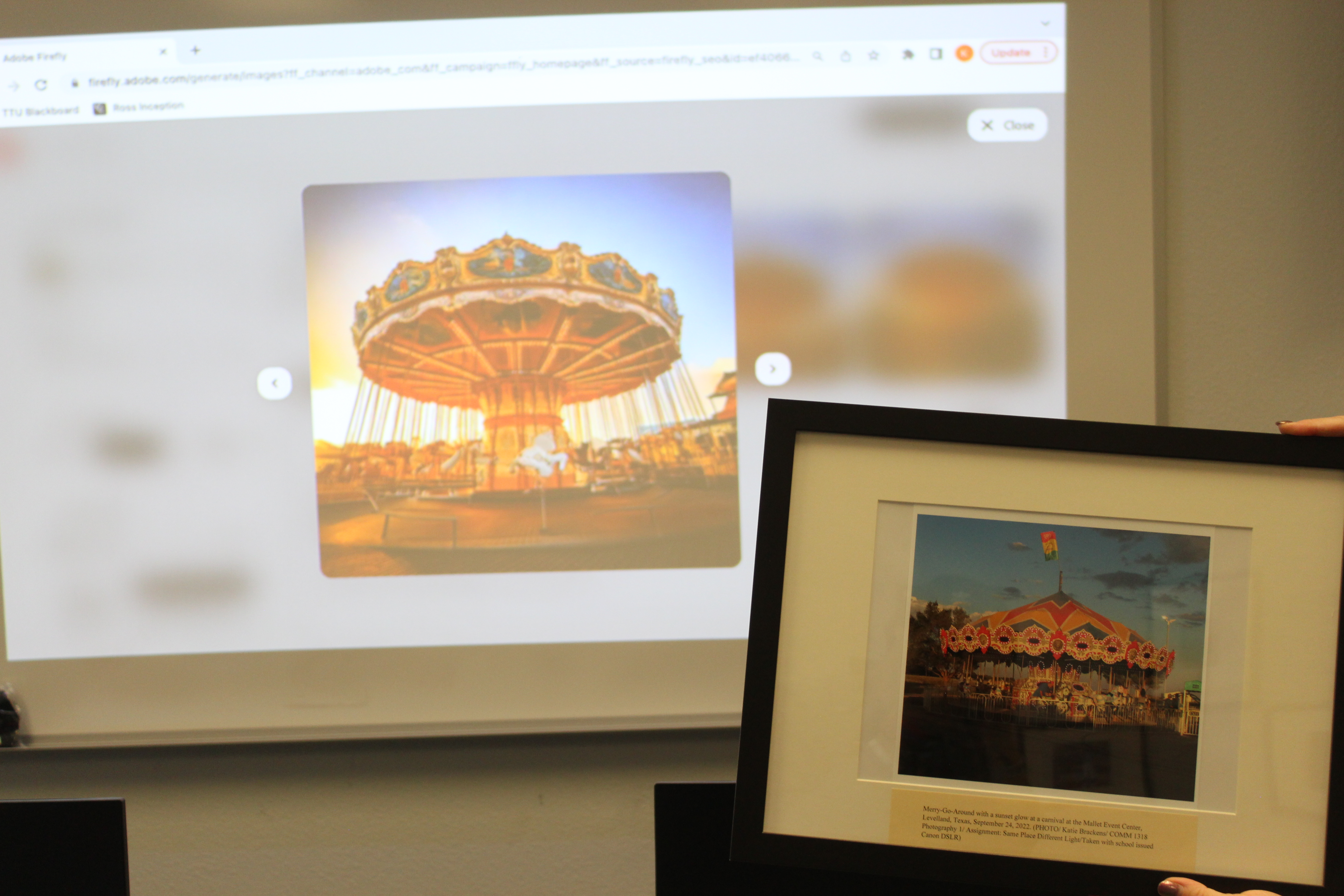
By Charlotte Baldi/COMM 2311.001
Artificial intelligence (AI) is still evolving in education and has the potential to personalize learning and tailor content to individual students. According to Forbes, AI-powered educational technology provides tools for teachers, students, and administrators.

AI can be a tool for students, if it is used ethically. Opinions vary about the use of AI in the classroom, but most seem sure that faculty can eventually incorporate it in the classroom.
Heather Medley, the instructional designer and professional development coordinator at South Plains College, said the role of educators as it relates to AI is evolving. Medley is one expert who believes it’s important for educators to understand AI.
“Educators are going to need AI to teach AI,” said Medley. “AI is not going anywhere, and I think the possibilities are incredible with what we can do with AI and how we can differentiate instruction and how we can tailor things to individual students with more ease.”
Medley mentions the importance of teaching students how to use AI ethically and responsibly. She tells students they worked hard to get to college and to not give that up over plagiarism.
“If you look at the percentage of students who go on post-high school, do not give up your voice,” said Medley. “You worked hard to get a seat at the table. Do not give that up. Your creativity, your voice, your experiences, what you bring to the table is valuable.”
According to Anthology, now that generative AI technologies are widely available to learners and AI plagiarism is growing as a consequence, an ethical approach to plagiarism must be reconsidered.
Medley says educators need to adapt their teaching methods to incorporate AI effectively. She also argues that AI can help students understand the underlying concepts rather than just memorizing facts.
“Now that we have AI, it’s going to be about challenging thinking, doing things different ways, because I can look up anything,” said Medley. “I don’t need to know what happened in 1776 off the top of my head, most of us do. I don’t need to test students on that because they can look it up.”
A 2023 Pew Research Center survey revealed that a significant portion of K-12 educators are still uncertain about AI’s role in education. Catelynn Morris, a student at Texas Tech University, says that despite being a student at the collegiate level, she does not have a lot of experience with AI.
“I guess the only thing that I could think of is if I have an online-only course and they kind of use AI tendencies, but I’m more of a face-to-face learning student,” said Morris.
She mentions that AI has made the educational process more impersonal and that it has not made the educational process more efficient for her personally.
“I feel like it’s making it more impersonal because I feel like students rely on it more rather than using their own ideas,” said Morris. “So, I don’t think it’s really made anything efficient personally.”
But some students may use artificial intelligence without realizing it. For example, Morris says that she uses Grammarly, an AI tool, for essay writing to ensure proper grammar and sentence structure.
“It kind of helps me whenever it comes to writing an essay, to make sure that my grammar is on point, the flow of how I put things and that sort of thing,” said Morris.
Morris expressed her concern about privacy, particularly the risk of AI bots hacking into student systems. She also worries that reliance on AI might lead to a loss of communication skills and affect academic fairness.
“If I was a student who did use or who did choose to learn with ChatGPT when it comes to hacking, I’m kind of weary on if the AI bot is going to hack into my system,” said Morris. “Another concern that I have is that students might lose a minor bit of communication skills because if they rely on AI features to teach them, they’re not really learning too efficiently.”
Morris expressed that she thinks universities should have a course that teaches AI to students and how they can use it properly.
“I feel like it might be beneficial for universities to require like a one credit hour [course] on how to use AI appropriately as like a fall semester course for incoming freshman,” said Morris. “It could be like an online-only course that way, so a student knows how to correctly use AI.”
AI is always evolving and changing the way people perceive things and technology. Stanford University offers a teaching guide for AI to help faculty “warm up” to the idea of AI and teach it effectively. Offering this can be a resource at other universities to help faculty wanting to incorporate AI into the classroom.
Leave a Reply