
Story and photos by Kamryn Collins, COMM 2311-601/Newswriting
You hope you never have to call for an ambulance. But if you do, chances are paramedics will be some of the first responders to arrive.
Here at South Plains College you can become an EMT basic in as quick as one semester.
“For the EMT basic, it’s only one semester,” says SPC’s EMS Program Director Mason Powers. Powers has been teaching at the SPC Reese Center for a little over five years now.
“I worked at UMC EMS here in Lubbock for the majority of my EMS career,” says Powers. “At UMC EMS there are many roles from just a normal field paramedic to a field training officer, and a shift chief.”
Powers says he was a paramedic for about 18 years before turning to teaching full time. He says he loves to bring his field experience to the classroom because it blends naturally into the class.

“Our EMT basic class is always the biggest class, we can hold up to 48 students,” Powers says. “We typically have around 28 to 34 students, and most of the students in our basic class are fresh out of high school.”
Powers says all of SPC’s EMS programs are broken down into two distinct areas.
“The didactic portion,” he says, “or the classroom portion, which is mainly lecture. And the clinicals, where students can go to hospitals and ride in ambulances.”
Powers says SPC offers three different levels of EMS certification: basic, advanced, and paramedic. And there’s a big difference, he says, between a basic EMT and a paramedic. The difference has to with the range of skills and practice they can provide.
EMT, he explains, can do assessments, limited medications, ventilating patients, CPR, and oxygen administration.
“The advanced level, that’s where we learn how to intubate patients,” Powers says. “We also introduce a lot more medications that they are able to give and some more treatments, things like plural decompression where they stick a needle in the chest to relieve pressure.”
At the paramedic level, Powers explains, “The biggest thing that paramedic is gonna’ focus on, especially that first semester, is cardiology. Being able to look at and interpret an EKG.” An EKG, for those who’ve never seen “Grey’s Anatomy”, is an electrocardiogram. It records electrical signals of the heart.
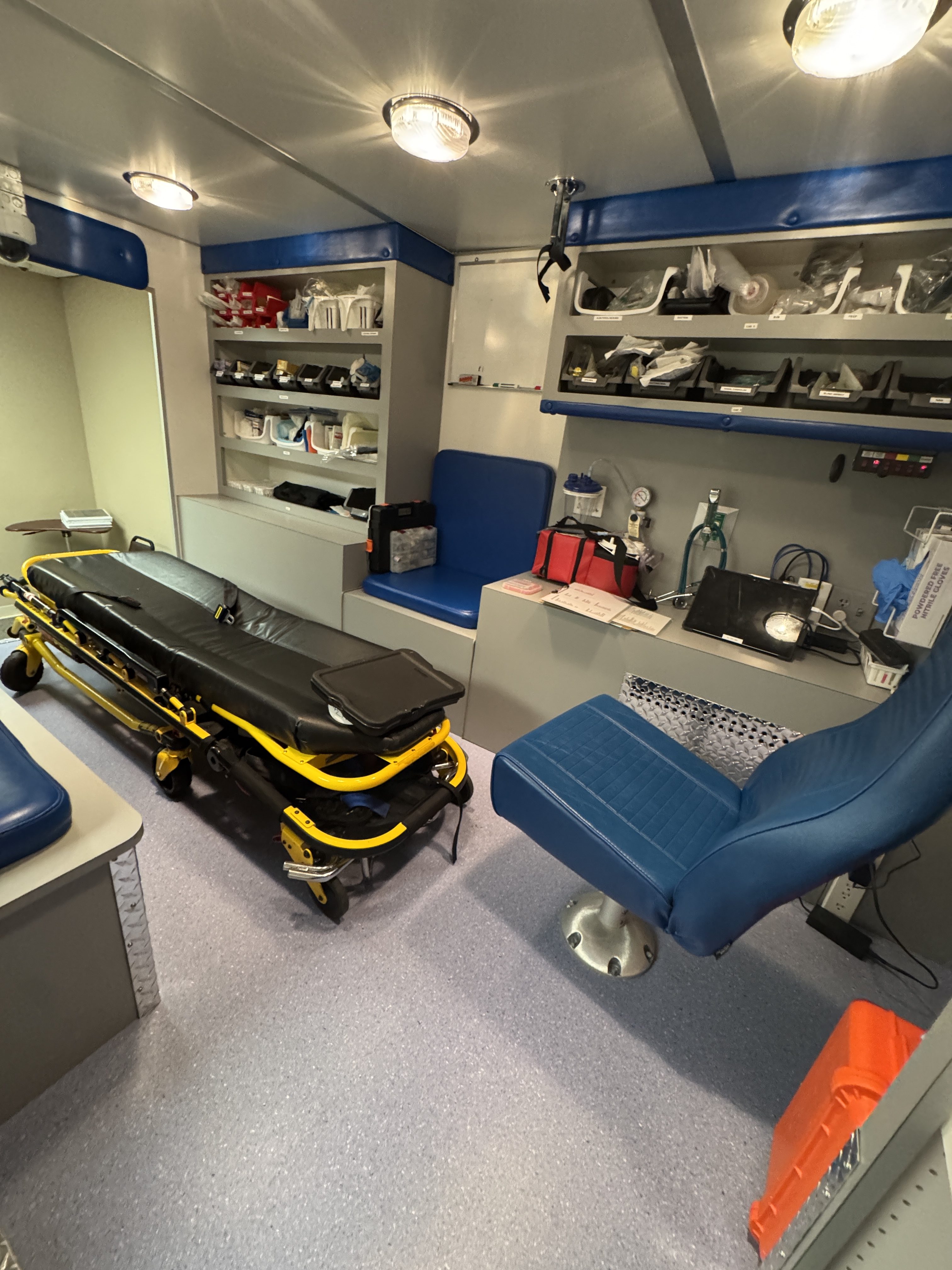
At the SPC Reese Center there is an ambulance simulator in the SIM lab. Powers explains it is set up to run exactly like an UMC ambulance.


“We’ll run our students through scenarios,” he says. “They’ll have to respond somewhere in the building or even in the parking lot to pick up a simulated patient, do what treatment they would do on scene and then wheel them into the back of the truck.”
Powers adds he believes patient assessment is kind of the foundation for all care.
“If our students can’t do a good assessment on the patient,” he says, “they’re not gonna’ get a full understanding of what’s going on with the patient. And then, if they don’t know what’s going on, they can’t treat the patient appropriately.”
The simulation lab includes fake limbs and blood. It also includes a car crash simulator with an air bag.


According to ZipRecruiter, the average hourly pay for an entry level EMT in Texas is $19.01. That’s current as of Nov. 19.
You can check out SPC’s EMS course information on the school’s website under Health Sciences and the Emergency Medical Services tabs. Mason’s contact information is also listed there.

Powers says one big advantage SPC’s EMS program has over some other programs is that a student can enter and exit the program kind of wherever they want to. That means someone can train and work at the same time.
“You can go through that basic and then you can exit the program,” he says. “Or if you want to continue, you still get certified at that basic level, but you can actually get a job on an ambulance for an EMS company while you’re going through your advanced and paramedic classes.”
Leave a Reply