
Editor’s note: Dylan Acosta, COMM 2311-601 Newswriting, contributed to this story.
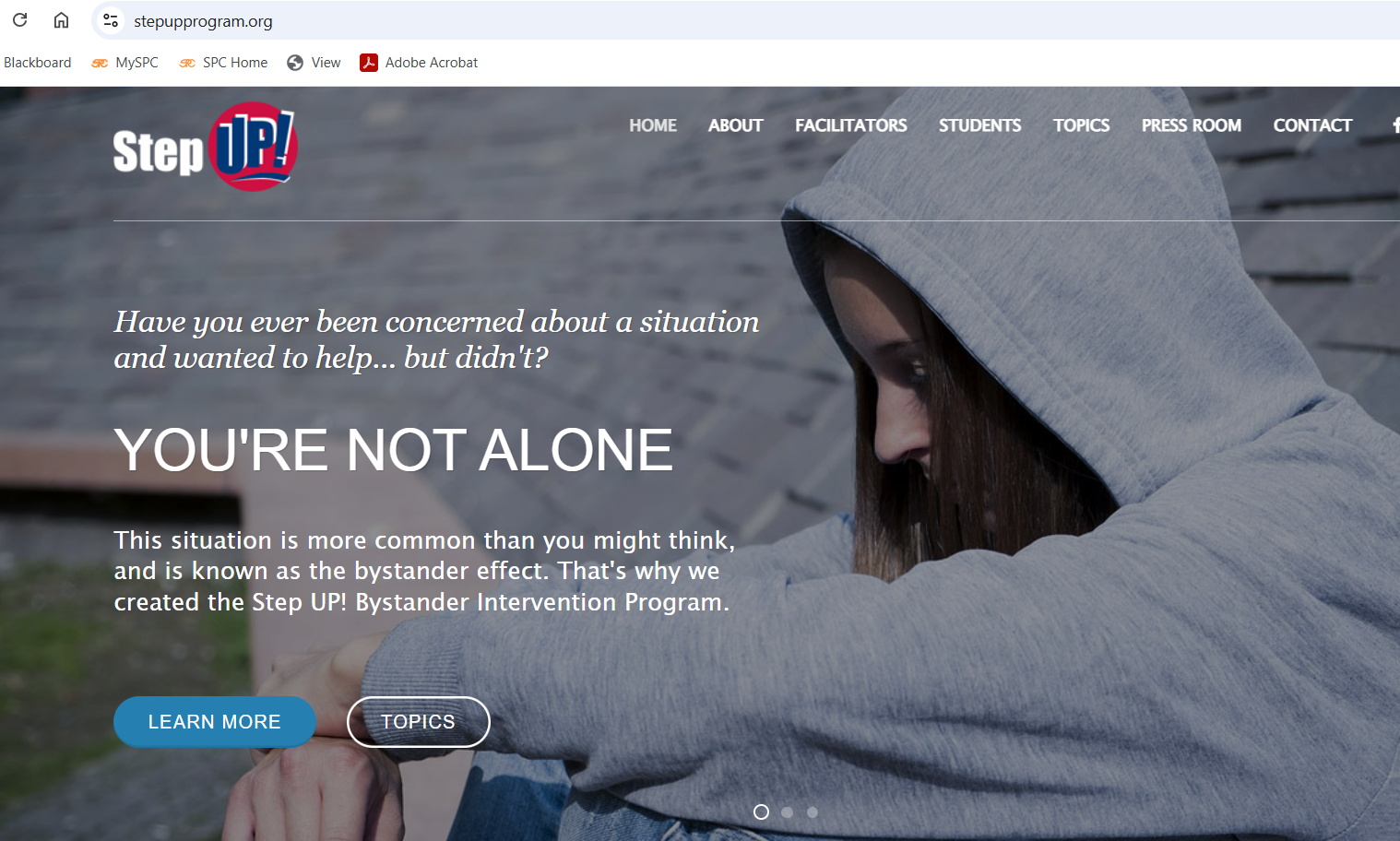
Have you ever been concerned about a situation and wanted to help…but didn’t?
That’s the exact question organizers at the national Step UP! Bystander Intervention Program want to help people tackle.
What is the “bystander effect? It has to do with that original question, when someone wanted to help someone else but didn’t. And according to Step UP! it is much more common than you may think.
An article in Psychology Today explains the bystander effect is a social psychology theory. It happens, the authors say, when the presence of others discourages an individual from intervening when there’s an emergency. The more bystanders there are, the less likely it is for any one of them to help a person in distress.

Step UP! calls itself a “prosocial behavior and bystander intervention program” that is designed to educate people how to be proactive in helping others. Its website has a long list of schools and organizations that use Step Up! materials.
Step UP! trainers are available through South Plains College. Recently two presenters were invited to meet with a Newswriting COMM 2311 class at the Lubbock Downtown Center. Licensed counselor Joanna Perez and licensed associate counselor Natalie Guerra spoke with about a dozen students for close to an hour about how to avoid the bystander effect.

The trainers asked students what they might do if they were faced with an emergency situation.

They used Powerpoints with graphics that offered practical advice about what they might do if they witness a troubling event involving topics such as anger, alcohol, depression, or sexual assault.

One slide listed five steps a person can follow if they witness something and want to help:
- Notice the event
- Interpret it as a problem
- Assume personal responsibility
- Know how to help
- Implement the help – Step UP!
In another part of the training, the counselors played a short video from reporters at NBC Today which showed what happened when they staged a child’s kidnapping on a crowded street in New York.

The video showed the child repeatedly shouting for help as a man grabbed her arm. The reporters said it took hours for people in the crowd to respond to the child’s cries for help.
That video, the counselors pointed out, is an example of what can happen when the bystander effect kicks in. They say videos like this one can be very helpful in teaching people the impact of the bystander effect. Additional videos are available on the StepUP! webpage.
Guerra says if there’s one thing she hopes students took away from this training, it’s that a person can take action even if they’re an “introvert”. She describes herself as an introvert, but she says she doesn’t have to have a lot of personal power to help someone.

“So, you don’t have to be a first responder to make a difference in somebody’s life,” she says.
Sometimes, Guerra says, you can make a difference by simply asking questions or stepping up to physically stand next to someone in need. All of those things are examples of what she says people can add to their mental “toolbox”.
Newswriting student Hannah Torres was in class the day Guerra and Perez made their presentation.
“I think it was very, um, knowledgeable,” Torres says, “and very like opened my mind to like what would I do and how would I do it in those instances.”
By the end of the presentation, Guerra said she doesn’t want people to forget about helping themselves in any kind of problem event. In other words, she says, there are times when we each might be expecting someone else to step up and help us. Yet, they don’t.

“And so that’s my last thing,” she says. “If people have let you down and have not done that for you, please come in and do that for yourself.”
She suggests people should not be afraid to reach out to counselors at SPC ‘s Health and Wellness. Both counselor/trainers listed their names and contact information on the classroom white board before they left.

“We can walk beside you,” Guerra says, “if that’s something that you need.”
Counseling services through SPC’s Health and Wellness are free for all current students. Appointments are available both in-person and online, accessible to students on all campuses Monday – Friday 8 a.m. to 4 p.m.
Leave a Reply