
Editor’s note: Photos from William Wilson, COMM 1318, Photography 1
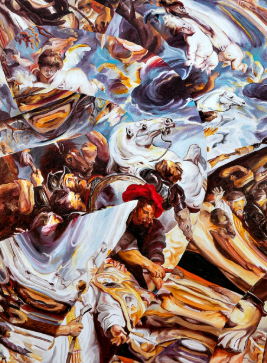
“Fluid color.” “Looks like war.” “A lot going on.” Those are some of the phrases a class of SPC students used to describe their first impression of one of artist Devin Ratheal’s paintings. The painting is called “Sans le Mot.” According to Google, that is a French phrase that literally means “without the word” or “without words.”
This painting is featured in the school’s announcement of Ratheal’s new solo exhibit.

The exhibit is called “Blasphemous Nerves,” and it’s on display now inside the South Plains College Main Art Gallery.

According to Texas Tech University’s website, Ratheal is a West Texas native who is currently a TTU lecturer teaching drawing and illustration. His personal website offers a picture of the artist and it features much of his work.

There are many paintings in the “Blasphemous Nerves” exhibit. Several of them are big. And many of them are not perfect rectangles or squares. Many of Ratheal’s paintings feature irregular yet familiar edges.


When your eye zooms in on a painting like “San le Mot,” you start to recognize hundreds of small images like parts of faces, some look like angels while others wear helmets.


Repeated images of horse heads are why one student said the “Sans le Mot” looked like “war”.
“The title ‘Blasphemous Nerves’ plays with the idea that our bodies perceive the world in ways that aren’t filtered through our beliefs,” Ratheal says. “You could say that our eyes don’t know what they’re looking at, while we simultaneously have the sense that we do.”


The TTU website says Ratheal is best known for his oil paintings on wood that “blend Renaissance and Baroque paintings with digital distortion to create works that appear to melt or explode onto the wall.”
The “melting” or “exploding” language echoes some of what students said in their first impression of Ratheal’s work. Instead of calling it “melting,” they called it “fluid.” Either one works.


Ratheal says his work is concerned with the role visual culture plays in supporting and/or destabilizing the stories we live with.
“The Christian paintings of the Renaissance and Baroque periods I reference,” he says, “were expressions and reinforcements of an organizing story for their culture, shaped to meet the demands of their time.”


When he’s preparing to make a new work, Ratheal says he often doesn’t know exactly what he wants to make.
First, he says, he goes through many images he’s saved of Renaissance and Baroque paintings until he finds an image that “resonates” with him maybe for composition or color. Next, he says he brings the image into Photoshop to start distorting it. Lastly, he says he transfers the digital reference onto canvas or wood and begins painting.

“Through all these steps,” he says, “I consider the process an open-ended one, where I’m collaborating with the images and paint, discovering the work more than trying to create something fully-formed from the outset.”
In the end, Ratheal says he hopes people who engage with his work will find it “visually interesting” and “vaguely familiar.”

“That space where you almost recognize something but can’t quite place it,” he says, “where the image hovers between the familiar and the strange, is where I think the most interesting viewing happens. My sincere hope is that viewers carry that strange perception out of the gallery and into the world.”
Ratheal’s exhibit is part of this year’s SPC Fine Arts Showcase, a campus-wide celebration of the arts.

Also, on view is “Vital Shreds: Studio Faculty Exhibition” featuring recent work from SPC studio art faculty. Both exhibits run through Oct. 17.
The SPC Art Galleries are located in the Christine Devitt Fine Arts Center on the SPC Levelland campus. The galleries are open weekdays from 8 a.m. to 4 p.m. (except campus holidays.) They are free to the public.
Leave a Reply