
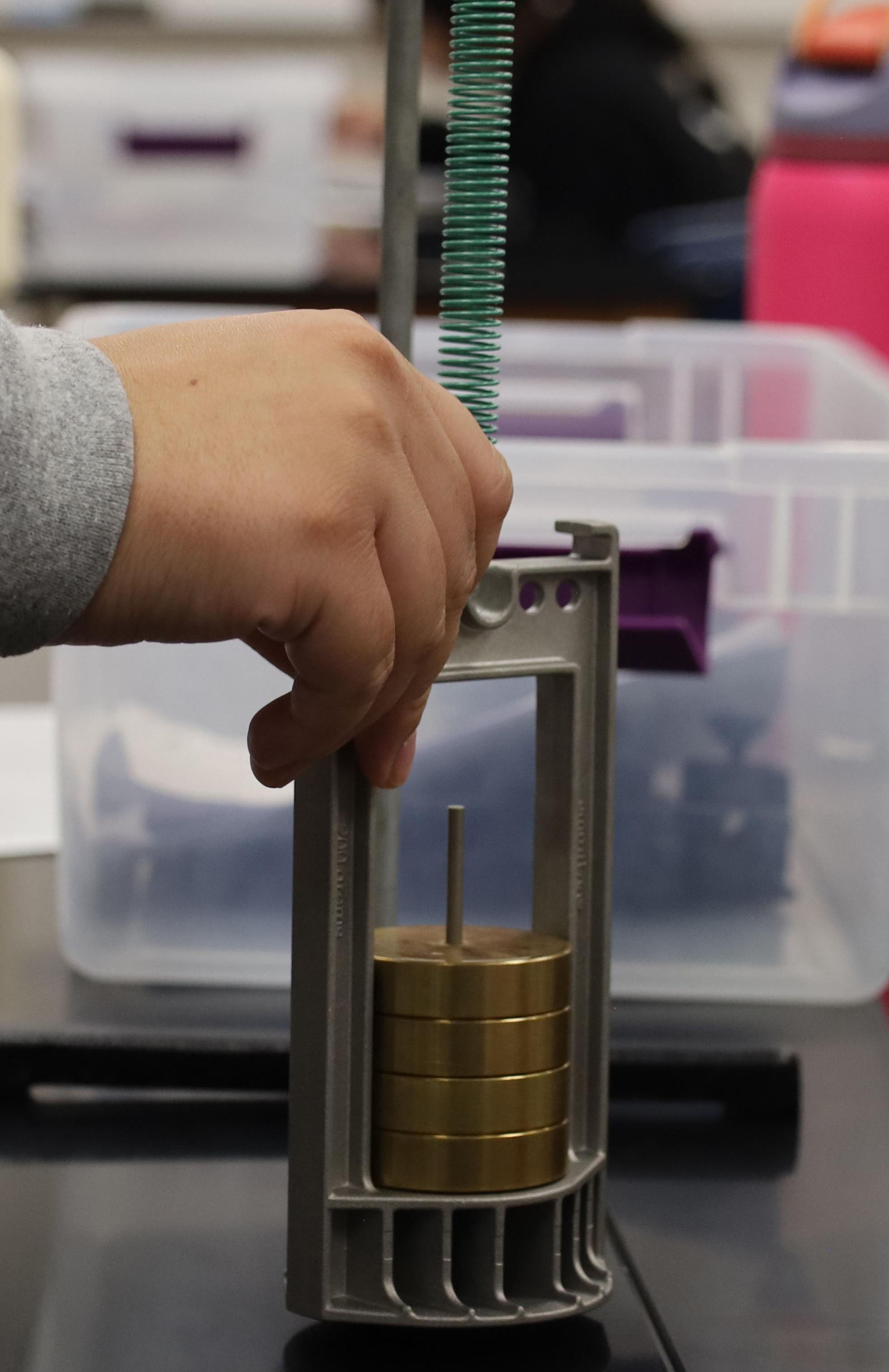
Big springs and weights took center stage in a recent physics lab in Physics 1401. Students were learning about something called Hooke’s Law.
“It tells you that if you pull a spring one way,” says Physics Professor Kim Bouldin, “there is a force pulling or pushing back the other way.”


She goes on to explain students in lab used weights to put a force on a spring to calculate the spring’s force constant. In other words, they measured how stiff or flimsy the springs were.
Student Micah Pappas says it’s been “pretty interesting” so far.
“We did the math first in the lecture on Tuesday, and now we’re applying it in lab,” he says.


According to the website geeksforgeeks.org, described as an online platform for computer science and programming education, Hooke’s Law is a fundamental principle in the field of mechanics dating back to 1678.

Geeksforgeeks.org goes on to explain real life applications of Hooke’s Law include:
- Car spring-based shock absorbers;
- Mechanical watches and clocks; and
- Sports equipment such as trampolines.
Leave a Reply